Expand for code that loads packages and data
library(tidyverse)
library(haven)
library(tulaverse)
library(modelsummary)

titanic <- read_dta("../dta/titanic_passengers.dta") %>%
mutate(pclass = relevel(as_factor(pclass), ref = "3rd"))All else being equal, when you increase the sample size of a study, the uncertainty in your estimates decreases.
We can illustrate this using the Titanic data by making versions of the data with multiple copies of each observation. For example, our 1309-passenger dataset becomes 5236 “passengers” when we include 4 copies of each. I also made versions with 16 and 64 copies.
Below are the logit results. Each cell includes the logit coefficient with the standard error in parentheses. At the bottom is the log-likelihood of the model estimates.
library(tidyverse)
library(haven)
library(tulaverse)
library(modelsummary)
titanic <- read_dta("../dta/titanic_passengers.dta") %>%
mutate(pclass = relevel(as_factor(pclass), ref = "3rd"))# create copies of data
titanic_4x <- titanic %>%
slice(rep(1:n(), each = 4))
titanic_16x <- titanic_4x %>%
slice(rep(1:n(), each = 4))
titanic_64x <- titanic_16x %>%
slice(rep(1:n(), each = 4))
# fit models
model <- glm(survived ~ pclass + male + child,
family = binomial(link = "logit"),
data = titanic)
model_4x <- glm(survived ~ pclass + male + child,
family = binomial(link = "logit"),
data = titanic_4x)
model_16x <- glm(survived ~ pclass + male + child,
family = binomial(link = "logit"),
data = titanic_16x)
model_64x <- glm(survived ~ pclass + male + child,
family = binomial(link = "logit"),
data = titanic_64x)
modelsummary(
list("Orig N" = model, "4x" = model_4x, "16x" = model_16x, "64x" = model_64x),
gof_map = list(
list("raw" = "nobs", "clean" = "N", "fmt" = 0),
list("raw" = "logLik", "clean" = "Log-Likelihood", "fmt" = 3)
),
fmt = 3
)| Orig N | 4x | 16x | 64x | |
|---|---|---|---|---|
| (Intercept) | 0.205 | 0.205 | 0.205 | 0.205 |
| (0.129) | (0.064) | (0.032) | (0.016) | |
| pclass1st | 1.862 | 1.862 | 1.862 | 1.862 |
| (0.176) | (0.088) | (0.044) | (0.022) | |
| pclass2nd | 0.898 | 0.898 | 0.898 | 0.898 |
| (0.180) | (0.090) | (0.045) | (0.023) | |
| male | -2.499 | -2.499 | -2.499 | -2.499 |
| (0.148) | (0.074) | (0.037) | (0.019) | |
| child | 1.085 | 1.085 | 1.085 | 1.085 |
| (0.229) | (0.115) | (0.057) | (0.029) | |
| N | 1309 | 5236 | 20944 | 83776 |
| Log-Likelihood | -617.293 | -2469.174 | -9876.695 | -39506.780 |
----------------------------------------------------------------
                   Orig N           4x          16x          64x
                     b/se         b/se         b/se         b/se
----------------------------------------------------------------
survived
1.pclass            1.862        1.862        1.862        1.862
                  (0.176)      (0.088)      (0.044)      (0.022)
2.pclass            0.898        0.898        0.898        0.898
                  (0.180)      (0.090)      (0.045)      (0.023)
male               -2.499       -2.499       -2.499       -2.499
                  (0.148)      (0.074)      (0.037)      (0.019)
child               1.085        1.085        1.085        1.085
                  (0.229)      (0.115)      (0.057)      (0.029)
_cons               0.205        0.205        0.205        0.205
                  (0.129)      (0.064)      (0.032)      (0.016)
----------------------------------------------------------------
N                    1309         5236        20944        83776
ll               -617.293    -2469.174    -9876.695    -3.95e+04
----------------------------------------------------------------
Things to notice in this table:
In the example above, the estimate for \(\beta_{\texttt{child}}\) is 1.085. Again, because 1.085 is the maximum likelihood estimate, constraining the coefficient for child to any other value would produce a worse log-likelihood.
We can do exactly that: try out different candidate values for the \(\beta_{\texttt{child}}\) and compute the implied log-likelihood of the model.
What we will plot here is the difference between the maximum log-likelihood (when \(\beta_{\texttt{child}}\) is 1.085) and the log-likelihoods we get for other candidate values for \(\beta_{\texttt{child}}\).
calc_likelihood <- function(data, beta_range) {
  # First, check if child is a factor and convert to numeric if needed
  if(is.factor(data$child)) {
    # Convert factor to numeric (0/1)
    # Assuming child is coded as "Yes"/"No" or similar
    data$child_numeric <- as.numeric(data$child) - 1
  } else {
    # If already numeric, just use as is
    data$child_numeric <- data$child
  }

  # Initial model
  full_model <- glm(survived ~ factor(pclass) + male + child_numeric,
                   family = binomial(link = "logit"),
                   data = data)

  max_ll <- logLik(full_model)

  # Create results dataframe
  results <- data.frame()

  for (beta in beta_range) {
    # Create model with constraint
    constrained_model <- glm(survived ~ factor(pclass) + male + offset(beta * child_numeric),
                            family = binomial(link = "logit"),
                            data = data)

    # Calculate distance from max likelihood
    ll_diff <- as.numeric(max_ll - logLik(constrained_model))

    # Add results
    results <- rbind(results, data.frame(beta = beta, ll = ll_diff))
  }

  return(results)
}

beta_range <- seq(0, 2, by = 0.005)
results_1 <- calc_likelihood(titanic, beta_range)
results_1$model <- 1

ggplot(results_1, aes(x = beta, y = -ll)) +
   geom_line(data = subset(results_1, ll <= 10), color="red3") +
   geom_vline(xintercept = 1.085, linetype = "dashed", color = "grey") +
   labs(y = "Distance from Maximum Likelihood") +
theme_tula() 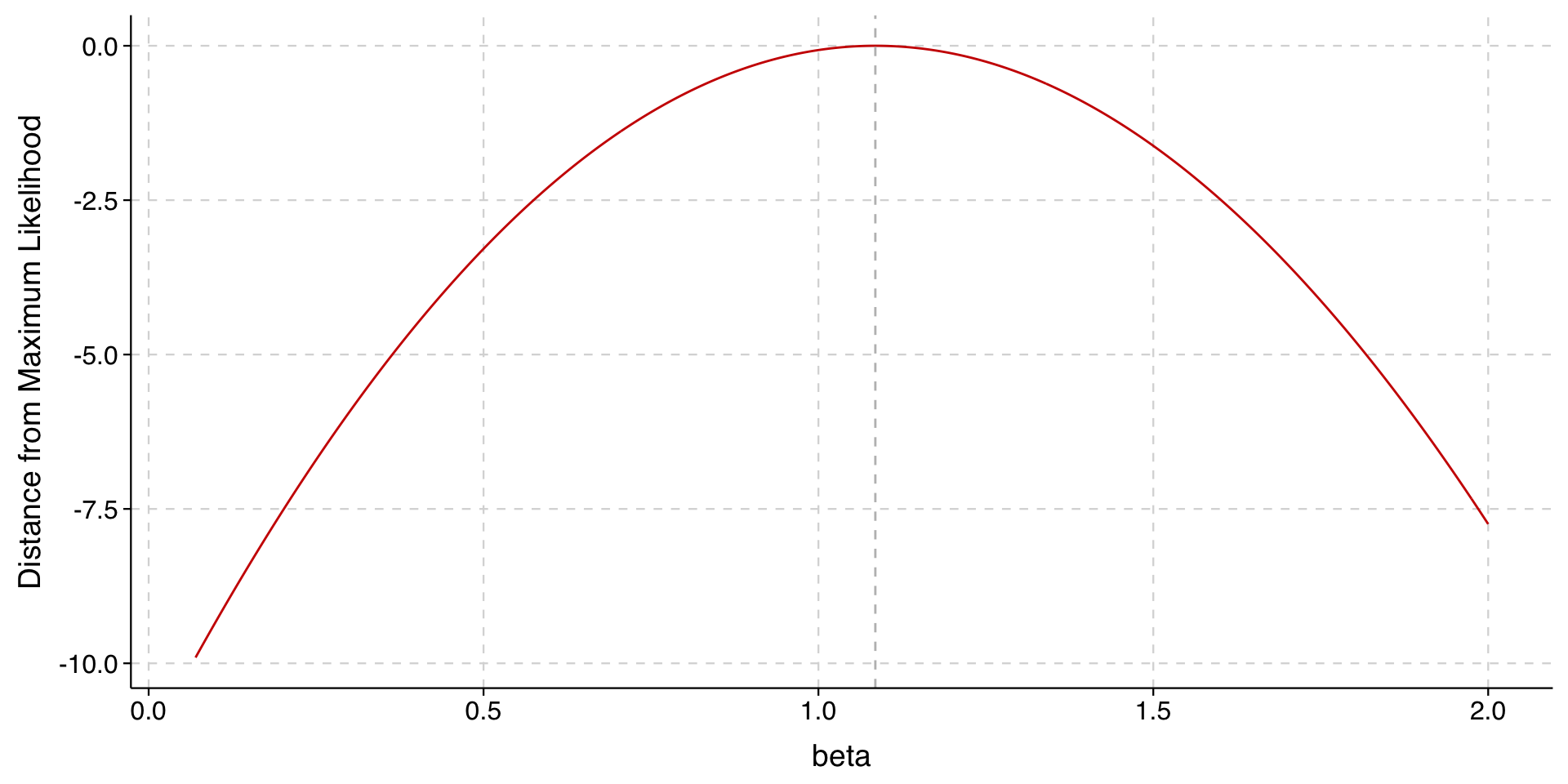
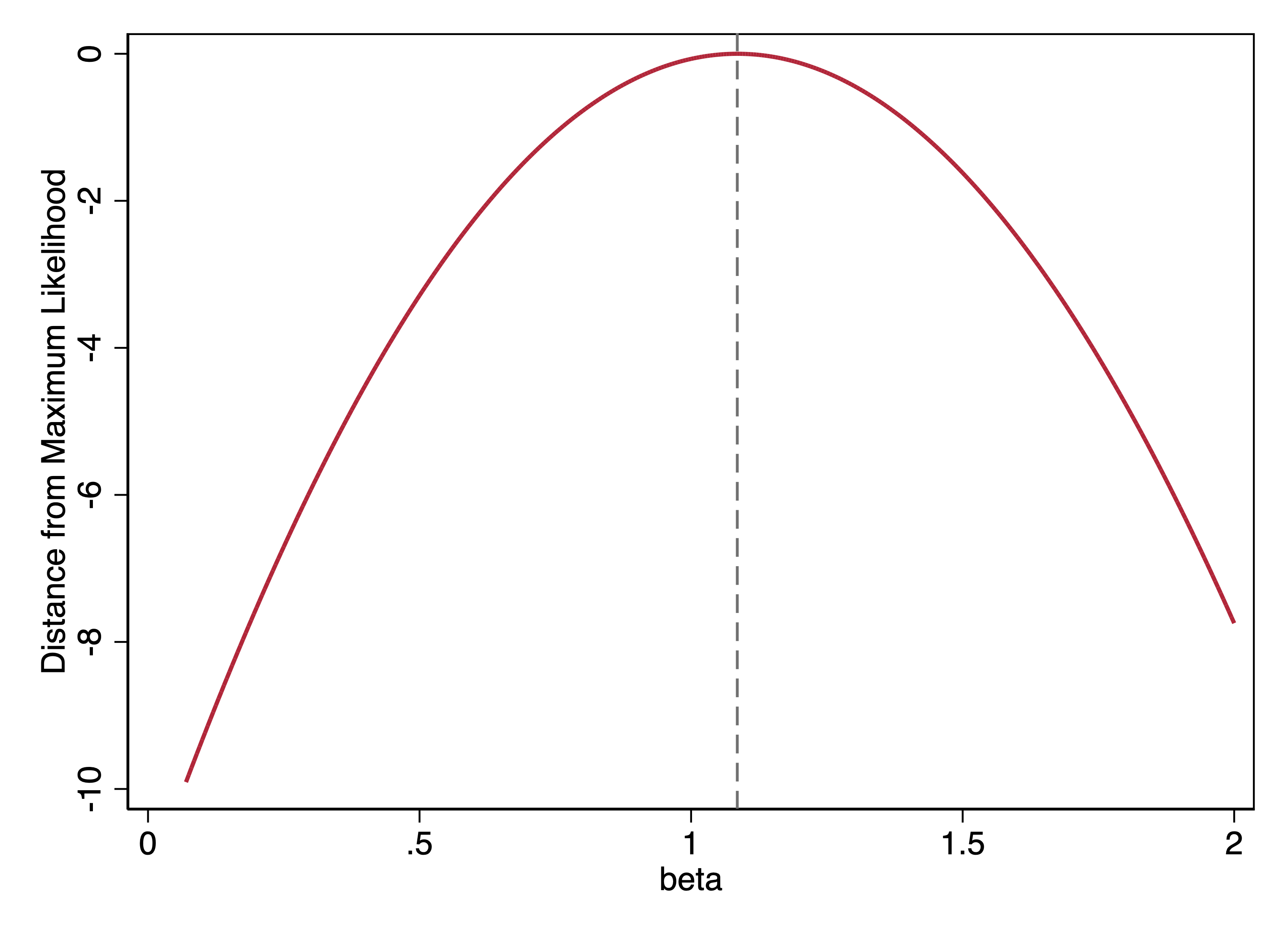
This is a graph of the likelihood function for our data and model with respect to \(\texttt{child}\).
On the \(y\)-axis, instead of the log-likelihood, I show the (negative) difference between the log-likelihood for the candidate beta and the maximum. At the maximum likelihood estimate of 1.085, \(y = 0\). At other values, \(y < 0\), where the farther one gets from 1.085, the larger the difference gets.
Here is the same graph, now adding the likelihood functions for our data with 4, 16, or 64 copies of each observation.
results_2 <- calc_likelihood(titanic_4x, beta_range)
results_3 <- calc_likelihood(titanic_16x, beta_range)
results_4 <- calc_likelihood(titanic_64x, beta_range)

results_2$model <- 2
results_3$model <- 3
results_4$model <- 4

all_results <- rbind(results_1, results_2, results_3, results_4) %>%
  mutate(ll = -ll)

ggplot(all_results, aes(x = beta, y = ll, color = factor(model))) +
   geom_line(data = subset(all_results, ll >= -10)) +
   geom_vline(xintercept = 1.085, linetype = "dashed", color = "grey") +
   labs(y = "Distance from Maximum Likelihood") +
   scale_color_manual(values = c("red3", "blue", "darkgreen", "orange"),
                      labels = c("Original N", "4x", "16x", "64x")) +
   theme_tula() +
  theme(
    legend.position.inside = c(0.05, 0.95), # Positions legend inside upper left
    legend.justification = c(0, 1),   # Anchors the legend to its top-left corner
    legend.background = element_rect(fill = "white", color = NA),
    legend.title = element_blank()    # Removes the legend title
  )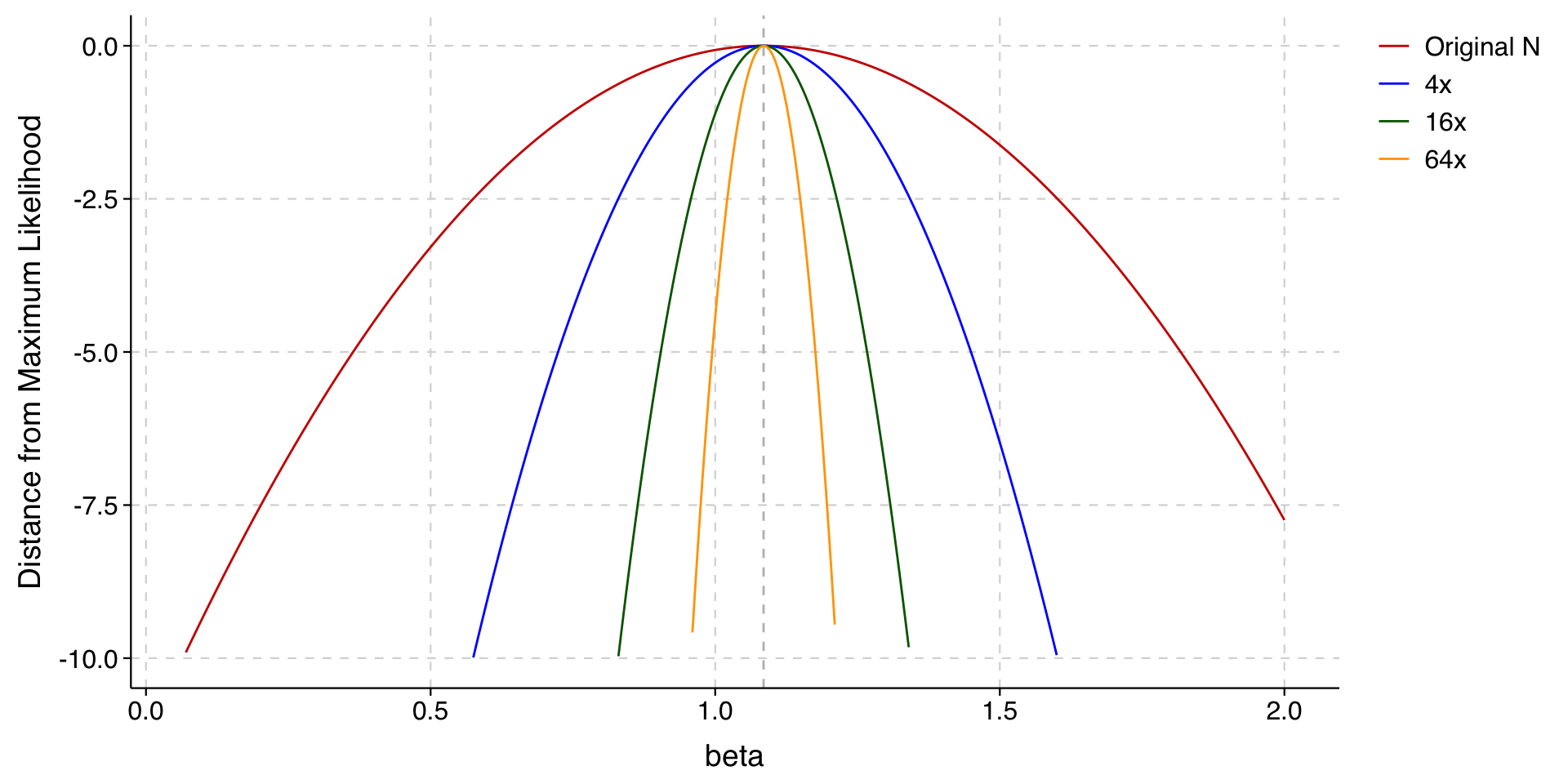
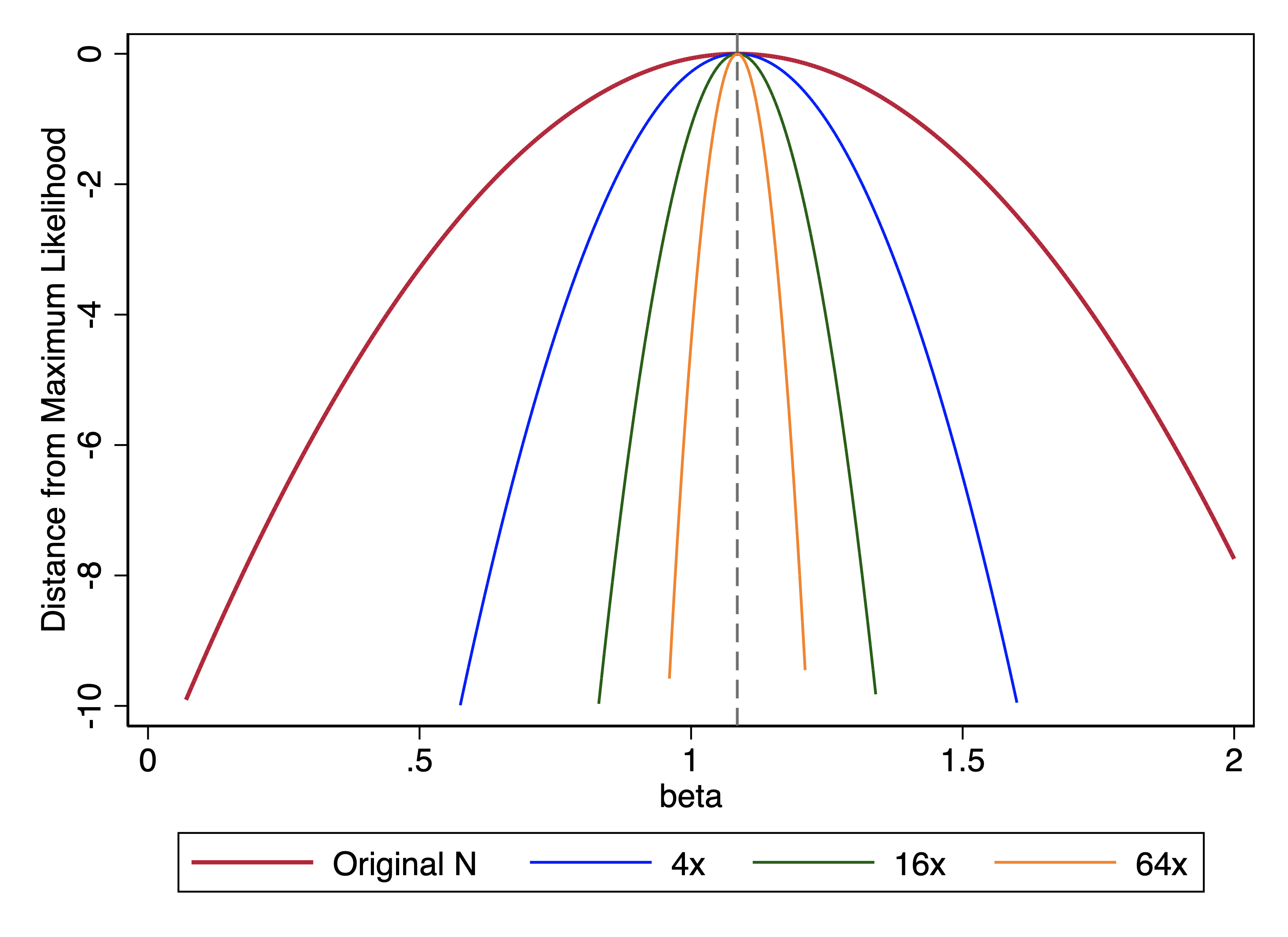
The maximum likelihood estimate is the same in all cases. But, as the sample gets larger, the function gets steeper (narrower around the point estimate).
At any given value on the \(y\)-axis, whenever we quadruple the sample, we make the likelihood function twice as narrow (i.e., we halve its width).
With maximum likelihood estimation, the maximum of the likelihood function provides our point estimate, and the steepness of the likelihood function is the basis for measuring uncertainty due to sampling variation. In a nutshell: