This first set of questions does not require you to do any data analysis yourself.
[1]When I refer to \(y^\ast\) in class, what does the \(\ast\) mean?
[1]In your own words, what does it mean for a variable to be latent?
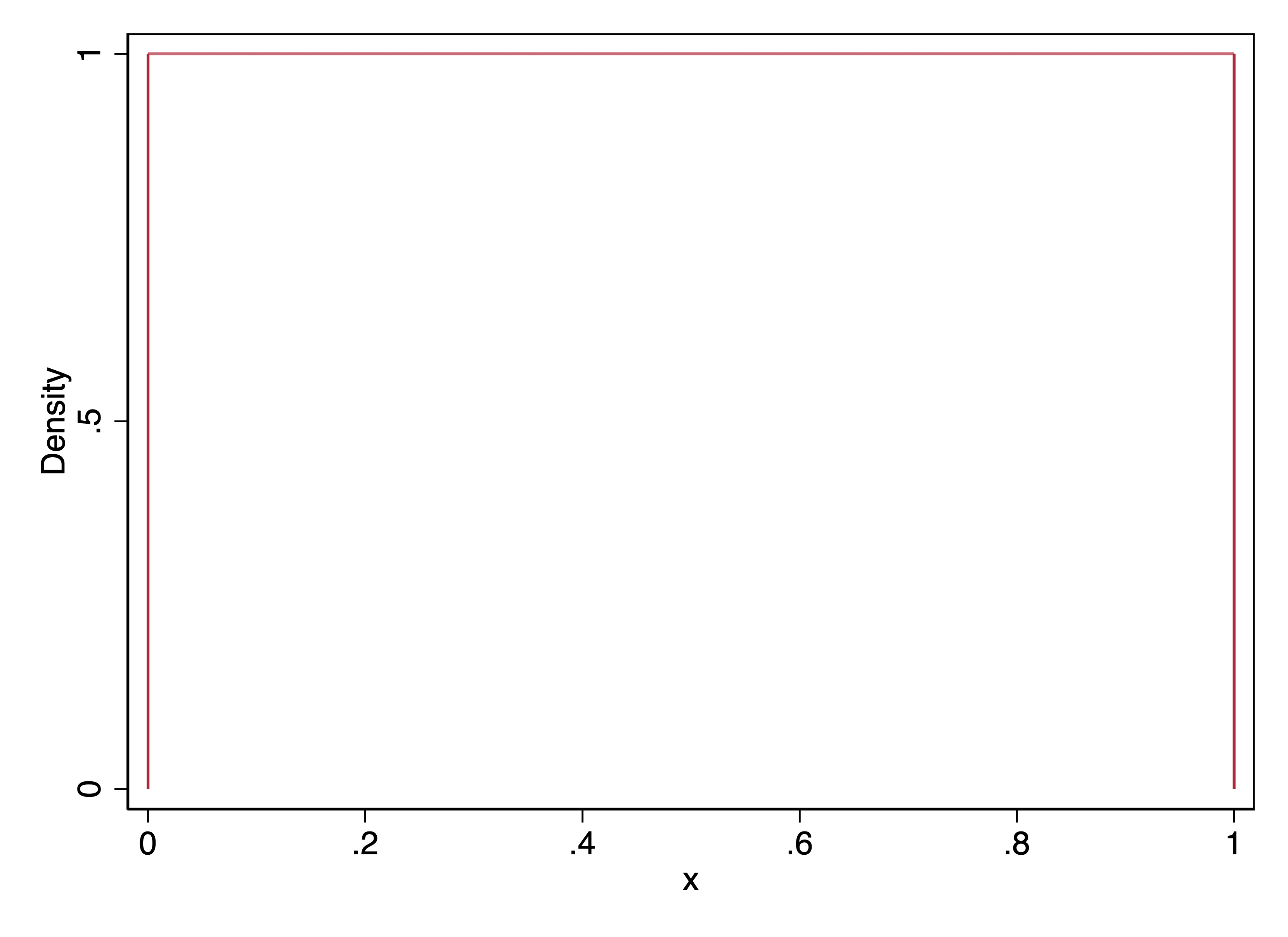
The uniform distribution is a distribution in which all real values with some interval are equally likely to occur. Here is what the probability density function of a uniform distribution bounded by 0 and 1 looks like.
Regarding the cumulative distribution function of this distribution:
[1]What is its value when x = 0?
[1]What is its values when x = 1?
[1]What is its value when x = .2?
[1]Say you fit a probit model and \(\mathbf{x}\mathbf{\beta}\) is -.4. What is the predicted probability that y = 1? (Show/explain how you calculate your answer.)
[1]You should never draw a substantive conclusion by directly comparing coefficients from a logit and probit model. Why not?
[3]Different reasons were provided for why, even though substantively one will almost certainly end up drawing the same conclusion, one might decide to use a logit model or a probit model for a binary outcome. In your view, which of these seemed the best reason and why?
The remaining items are premised on you doing some data analysis yourself.
Start with whatever is the logit model you have fit so far in the class that has the most explanatory variables. (If there’s a tie, choose whichever.)
[5]Make a pleasant-looking table which compares the results of the logit model (presented under the column heading “Logit”) with the results of the probit model with the same explanatory variables (presented under the column heading “Probit”).
[1]Which log-likelihood is better in your example: the log-likelihood from the logit model or the log-likelihood from the probit-model?
[2]Do the coefficients differ in a systematic way between the two models? Hopefully this is as you expected: explain why or why not.
[2]Do the z-statistics differ much between the two models? Hopefully this is as you expected: explain why or why not.